

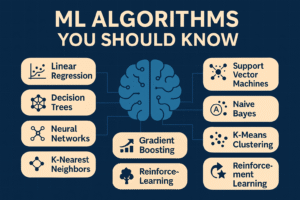
ML Algorithms You Should Know
Machine Learning (ML) is no longer a buzzword—it’s a foundational technology powering everything from recommendation engines to fraud detection systems. Whether you’re a developer, data scientist, or tech enthusiast, understanding key ML algorithms is crucial.
In this post, we’ll explore the most important ML algorithms, how they work, and where they’re used. Let’s dive in!
1. Linear Regression
Use Case: Predicting continuous values (e.g., house prices, sales forecasts)
Linear regression is the simplest form of supervised learning. It models the relationship between a dependent variable and one or more independent variables using a straight line.
Why it matters: It’s easy to interpret and serves as a great starting point for regression problems.
2. Decision Trees
Use Case: Classification and regression tasks
Decision trees split data into branches to make predictions. They’re intuitive and mimic human decision-making.
Pros: Easy to visualize
Cons: Prone to overfitting
Learn more from Scikit-learn’s Decision Tree Guide
3. Neural Networks
Use Case: Image recognition, NLP, deep learning
Inspired by the human brain, neural networks consist of layers of interconnected nodes. They’re the backbone of deep learning.
Popular Frameworks: TensorFlow, PyTorch
Tip: Use neural networks when your data is large and complex.
4. K-Nearest Neighbors (KNN)
Use Case: Pattern recognition, recommendation systems
KNN classifies data based on the majority label of its nearest neighbors. It’s simple but powerful for small datasets.
Drawback: Slower with large datasets
5. Support Vector Machines (SVM)
Use Case: Text classification, image recognition
SVMs find the optimal boundary between classes. They work well in high-dimensional spaces and are effective for binary classification.
6. Naive Bayes
Use Case: Spam detection, sentiment analysis
Based on Bayes’ Theorem, this algorithm assumes independence between features. Despite its simplicity, it performs surprisingly well in many applications.
7. K-Means Clustering
Use Case: Customer segmentation, anomaly detection
K-Means is an unsupervised learning algorithm that groups data into clusters based on similarity. It’s fast and scalable.
Note: You need to predefine the number of clusters (K).
8. Random Forest
Use Case: Fraud detection, recommendation engines
Random Forest is an ensemble method that builds multiple decision trees and merges them for better accuracy and stability.
Advantage: Reduces overfitting compared to a single decision tree.
9. Gradient Boosting (XGBoost, LightGBM)
Use Case: Kaggle competitions, predictive modeling
These are advanced ensemble techniques that build models sequentially to correct errors from previous ones. They’re highly accurate and widely used in production.
10. Reinforcement Learning
Use Case: Robotics, game AI, self-driving cars
This algorithm learns by interacting with an environment and receiving feedback in the form of rewards or penalties.
Check out OpenAI Gym to experiment with RL environments
Choosing the Right Algorithm
There’s no one-size-fits-all. Your choice depends on:
- Data size and type
- Problem type (classification, regression, clustering)
- Accuracy vs interpretability
- Training time and resources
Internal Links
- How AI Is Revolutionizing Cybersecurity
- The Rise of Generative AI in Content Creation
- AI Tools for Developers
External Links
Final Thoughts
Machine learning is evolving rapidly, and staying updated with core algorithms is essential. Whether you’re building a chatbot or optimizing a supply chain, these algorithms form the backbone of intelligent systems.
Want to explore more? Subscribe to our newsletter or check out our AI Tools for Developers post.




Leave A Comment